Category: political-news

  • Significance of Party Manifestos in Lok Sabha Elections

    Significance of Party Manifestos in Lok Sabha Elections

    Lok Sabha Elections: In the realm of Indian politics, the party manifesto plays a pivotal role in shaping electoral outcomes and influencing voter decisions. Let’s delve into why these documents hold such paramount importance and assess the extent to which major political entities like the Congress and the BJP have fulfilled their promises.

    Understanding the Importance of Party Manifestos

    Party manifestos serve as comprehensive blueprints outlining the vision, policies, and commitments of political parties vying for power. These documents are crafted meticulously to resonate with the electorate, addressing their concerns and aspirations while articulating the party’s agenda for governance. From economic reforms to social welfare schemes, manifestos encapsulate a party’s promises and priorities, essentially serving as a contract between the party and the electorate.

    The Role of Manifestos in Voter Decision-Making

    In a democratic setup like India, where elections are fiercely contested, manifestos play a crucial role in swaying voter sentiment. They provide voters with insights into a party’s ideological stance, policy proposals, and plans for addressing pressing issues. By scrutinizing these documents, voters can evaluate the feasibility and sincerity of a party’s promises, enabling them to make informed choices at the ballot box. Thus, manifestos serve as a yardstick against which parties are held accountable for their performance post-election.

    Analyzing the Fulfillment of Manifesto Promises

    Now, let’s turn our attention to the performance of two prominent political entities in India – the Indian National Congress (INC) and the Bharatiya Janata Party (BJP) – concerning the implementation of their manifesto pledges.

    Congress Manifesto Implementation

    The Congress party, a stalwart in Indian politics, has historically placed emphasis on inclusive growth and social welfare. In its manifestos, the party often highlights its commitment to alleviating poverty, promoting education, and fostering economic development. However, the extent to which these promises have been realized remains subject to scrutiny.

    Over the years, the Congress has initiated various welfare schemes and developmental projects aimed at uplifting marginalized sections of society. Initiatives such as the Mahatma Gandhi National Rural Employment Guarantee Act (MGNREGA) and the National Food Security Act (NFSA) reflect the party’s endeavor to address poverty and hunger. Additionally, the implementation of educational reforms and healthcare initiatives underscores its commitment to human development.

    However, critics argue that the Congress has faltered in delivering on several fronts, citing instances of corruption and administrative inefficiencies. Despite its earnest efforts, the party’s governance record has been marred by controversies and policy paralysis, casting doubts on its ability to fulfill manifesto promises effectively.

    BJP’s Manifesto Realization

    In contrast, the Bharatiya Janata Party (BJP), under the leadership of Prime Minister Narendra Modi, has emerged as a formidable force in Indian politics, advocating for a blend of nationalism and development. The party’s manifestos reflect its commitment to economic reforms, infrastructure development, and national security.

    Since assuming power at the center in 2014, the BJP has embarked on ambitious initiatives such as “Make in India” and “Digital India,” aimed at fostering entrepreneurship and modernizing the economy. Moreover, the implementation of flagship schemes like the Goods and Services Tax (GST) and the Pradhan Mantri Jan Dhan Yojana (PMJDY) underscores the party’s focus on economic transformation and financial inclusion.

    Furthermore, the BJP’s emphasis on bolstering national security and combating terrorism has garnered widespread support among the electorate. Measures such as surgical strikes against militant outfits and initiatives to strengthen border security resonate with the party’s manifesto commitments, reinforcing its image as a stalwart guardian of national interests.

    However, detractors accuse the BJP of pursuing divisive policies and undermining democratic institutions, raising concerns about the erosion of civil liberties and religious harmony. Despite its notable achievements, the party faces scrutiny over its handling of socio-political issues and its commitment to upholding constitutional values.
  • Lok Sabha Elections: The Political Dynamics Unfolding in Bihar’s Karakat Seat

    Lok Sabha Elections: The Political Dynamics Unfolding in Bihar’s Karakat Seat

    The Countdown to Lok Sabha Elections

    With just a week left until the commencement of the Lok Sabha elections, the political atmosphere is ablaze with anticipation. The voting for the first phase is set to kick off on April 19. As the election date draws nearer, the political fervor is intensifying, especially in Bihar, where the electoral battle on the Karakat seat has become particularly intriguing. Bhojpuri superstar and singer Pawan Singh has announced his candidacy as an independent contestant from Karakat.

    Pawan Singh’s Entry into the Fray

    While Pawan Singh gears up to enter the political arena as an independent candidate, former minister Upendra Kushwaha stands with his ‘National Lok Morcha.’ Allegations abound that Pawan Singh is contesting from Karakat at the behest of the BJP. Seema Kushwaha, the leader of the Development-oriented People’s Party, claims that the BJP is grooming Pawan Singh to defeat Upendra Kushwaha. She questions why Pawan Singh isn’t contesting from his home district of Ara.

    Rejecting a Ticket from Asansol

    Pawan Singh’s decision to contest the elections has injected new life into the political scene of Bihar’s Karakat region. He recently turned down a ticket from Asansol, West Bengal, which was offered to him by the BJP. However, the next day, he surprised everyone by announcing his decision not to contest from Asansol. Instead, he declared his intention to contest from Karakat, placing his party in a strategic position.

    Understanding the Electoral Calculus of Karakat

    In Karakat, Upendra Kushwaha represents the NDA, while the Mahagathbandhan has nominated Rajaram Kushwaha from CPI-ML. Pawan Singh’s entry into the fray has turned the contest into a triangular one between two Kushwaha leaders and the Bhojpuri star, creating a complex political scenario. When ABP News approached NDA’s candidate and National Lok Morcha’s chief, Upendra Kushwaha, for comment, he evaded direct answers.

    Regarding Pawan Singh’s candidacy, he remarked that being a science student, Pawan might find it challenging to address commerce-related issues. In contrast, Upendra Kushwaha emphasized the broad-based support he is receiving across all sections of society.

    Demographic Analysis of Karakat

    A closer look at the demographic makeup of Karakat reveals approximately 300,000 Yadav voters, nearly 250,000 Kurmi-Koiri voters, and an equal number of Rajput voters. Additionally, there are around 200,000 Vaishya voters, along with a Muslim population of approximately 150,000.

    Significance of Pawan Singh’s Candidacy in Karakat

    Pawan Singh’s decision to contest from Bihar’s Karakat Lok Sabha seat holds significant implications. His candidacy not only appeals to Rajput voters but also resonates with the youth electorate. If Pawan Singh manages to sway the Rajput voters in his favor, his victory in the Lok Sabha elections becomes highly probable. Until 2009, this seat was known as Vikramganj, where leaders from the Rajput community held sway. However, the demographic landscape shifted post-2009, with leaders from the Koeri community dominating the political scene.

  • Rahul Gandhi On Agnipath Scheme: मोदी सरकार ने किया युवाओं के सपनों का अपमान

    Rahul Gandhi On Agnipath Scheme: मोदी सरकार ने किया युवाओं के सपनों का अपमान

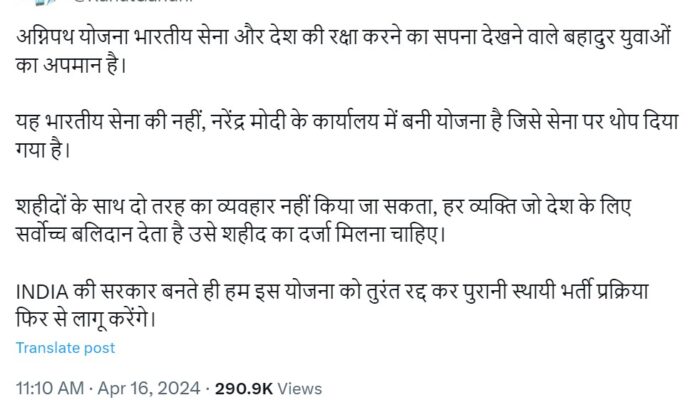
    Rahul Gandhi On Agnipath Scheme: देश का सियासी पारा बढ़ा हुआ है। बीजेपी के विरोध में विपक्ष लगातार बयानबाजी कर रहा है और उनकी नीतियों पर सवाल उठा रहा है। कई राजनीतिक जानकारों का मानना है की अबकी बार का चुनाव कई बड़े परिवर्तन लेकर आया है। सपा अध्यक्ष अखिलेश यादव का कहना है गुजरात में बीजेपी विरोध में जारी क्षत्रिय विरोध की आंच यूपी तक धड़क रही है। अबकी राजपूत समाज में बीजेपी को नकारने का मूड बना लिया है। वहीं अब कांग्रेस नेता राहुल गांधी ने बीजेपी पर सेना में भर्ती होने का सपना देख रहे युवाओं का अपमान करने का आरोप लगाया है।

    राहुल गांधी ने एक्स पर लिखते हुए कहा- अग्निपथ योजना भारतीय सेना और देश की रक्षा करने का सपना देखने वाले बहादुर युवाओं का अपमान है। यह भारतीय सेना की नहीं, नरेंद्र मोदी के कार्यालय में बनी योजना है जिसे सेना पर थोप दिया गया है। शहीदों के साथ दो तरह का व्यवहार नहीं किया जा सकता, हर व्यक्ति जो देश के लिए सर्वोच्च बलिदान देता है उसे शहीद का दर्जा मिलना चाहिए। INDIA की सरकार बनते ही हम इस योजना को तुरंत रद्द कर पुरानी स्थायी भर्ती प्रक्रिया फिर से लागू करेंगे।


Rahul Gandhi On Agnipath Scheme:

    राहुल के बयान पर यूजर्स की यूजर्स की प्रतिक्रिया:

    सूर्या नामक एक यूजर कहता है – सेना में ज्यादातर गरीब घर के लोग जाते है जिससे उनके परिवार की आर्थिक स्थिति मजबूत हो जाती है लेकिन मोदी ने अग्नीवीर योजना लाकर गरीब युवाओं के सपनो को मार दिया। एक अन्य यूजर कहता है – अग्निपथ स्कीम मे एक यह संशोधन किया जाना चाहिए कि जिस भी अग्निवीर को 4 साल देशसेवा के बाद रिटायरमेंट लेना है वो ले सकता है, और जिस अग्निवीर को पूर्णकालिक सेैनिक बनकर देशसेवा करना है वो पूर्णकालिक सेवा दे सकता है।

  • Rahul Gandhi Rally in Kerala, Amit Shah’s Road Show in Gujarat, JP Nadda’s Assam Visit, and Yogi Adityanath’s Public Meeting in UP

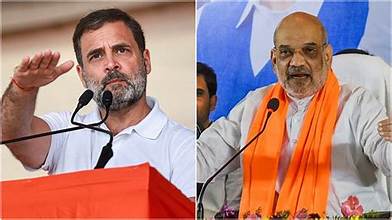
    Rahul Gandhi Rally in Kerala, Amit Shah’s Road Show in Gujarat, JP Nadda’s Assam Visit, and Yogi Adityanath’s Public Meeting in UP

    Energizing Political Enthusiasm in Kerala

    Rahul Gandhi, the dynamic leader of the Indian National Congress, ignited fervor among the masses during his recent rally in Kerala. The event showcased his vision for the state’s progress and his unwavering commitment to the welfare of its people.

    Amit Shah’s Vibrant Road Show in Gujarat

    Amit Shah, the stalwart of the Bharatiya Janata Party, electrified Gujarat with his vibrant road show. As he traversed through the streets, he connected with the citizens, conveying the party’s agenda and garnering support for its initiatives.

    JP Nadda’s Strategic Visit to Assam

    JP Nadda, the president of the BJP, strategically visited Assam, emphasizing the party’s dedication to the region’s development. His interactions with the locals underscored the BJP’s inclusive approach and its resolve to address their concerns.

    Yogi Adityanath’s Inspiring Public Meeting in Uttar Pradesh

    Yogi Adityanath, the Chief Minister of Uttar Pradesh, held an inspiring public meeting in the state. With his charismatic presence and visionary discourse, he galvanized the audience, instilling confidence in the BJP’s leadership and its transformative agenda.

  • India’s Population Control Measures: A Historical Perspective

    India’s Population Control Measures: A Historical Perspective

    India’s Population Control Measures: India has grappled with the perennial concern of its burgeoning population for decades. Since 1951, the country has been exploring various avenues to curb the population growth, with one notable approach being the implementation of sterilization, also known as “nasbandi.” However, during the emergency period in the 1970s, forced sterilization emerged as a significant political issue.

    Forced Sterilization During the Emergency

    In 1975, during the emergency period, millions of men were forcefully sterilized. It is said that Sanjay Gandhi, the younger son of the then Prime Minister Indira Gandhi, vigorously promoted this campaign. The most vulnerable targets of this initiative were the economically disadvantaged population.

    During this time, police would cordon off entire villages, and men would be subjected to coerced sterilization. According to reports, approximately 6.2 million people were sterilized within a year. Tragically, this period also saw the deaths of around 2,000 innocent individuals due to botched operations.

    Understanding Sterilization

    Sterilization is a permanent contraceptive method that involves the cessation of reproductive capability in men or women. Following sterilization, individuals are rendered incapable of conception or bearing children. In male sterilization, the vas deferens tube is either cut or sealed, preventing the passage of sperm from the testes. Similarly, in female sterilization, the fallopian tubes are either cut or blocked, hindering the passage of eggs from the ovaries to the uterus. Importantly, female sterilization does not affect menstruation or hormone levels.

    Rationale Behind the Sterilization Drive

    In 1951, India’s population stood at approximately 361 million. During the preceding decade (1941-1951), the country witnessed an annual population growth rate of 1.26%. Based on these trends, eminent demographer P.C. Mahalanobis projected that India’s population would increase by 5 million people each year.

    In response to Mahalanobis’s report, the Indian government initiated the National Family Planning Program, making India the first country in the world to undertake such a campaign. Under this initiative, extensive efforts were made to raise awareness about family planning, encouraging families to have no more than two children with a minimum two-year gap between births. However, the government’s efforts proved largely ineffective.

    Challenges and Economic Imperatives

    Gopalaswami’s report not only advocated for family planning but also suggested widespread sterilization as a means of population control. Sterilization, being a simple surgical procedure, was deemed cost-effective and minimally invasive. However, garnering public support for sterilization was no easy feat. There were numerous misconceptions surrounding the procedure, including fears of death, weight loss, fatigue, and loss of libido among men.

    Nevertheless, the prevailing belief among Indian policymakers was that population control was imperative for economic development. Consequently, various campaigns were launched at different phases, with a significant increase in budget allocation post-1965, when a separate department for family planning was established.

    International Pressure and Political Climate

    Between 1972 and 1980, the World Bank extended a loan of 66 million USD to the Indian government for sterilization efforts. Western nations exerted pressure on India to control its population, with Indira Gandhi being coerced into accelerating the sterilization campaign.

    The Coercive Era: Sanjay Gandhi’s Influence

    In the midst of economic turmoil and political instability in 1975, Indira Gandhi declared a state of emergency. It was during this period that Sanjay Gandhi, despite lacking any official position in the government or party, spearheaded the massive sterilization campaign. His sole qualification was being the Prime Minister’s son.

    A Paradigm Shift: Centralization of Family Planning Programs

    In 1976, significant changes were introduced to India’s constitutional framework under the leadership of Prime Minister Indira Gandhi. The amendment granted the central government the authority to execute family planning programs, marking a pivotal shift from state-level control. Subsequently, the central government facilitated the training of state-level leaders and implemented ambitious initiatives such as vasectomy camps and setting specific targets for population control.

    Sanjay Gandhi’s Vision: Addressing Population Growth

    Sanjay Gandhi recognized population growth as a critical impediment to India’s progress and emphasized the need for strict measures to regulate it. He entrusted state chief ministers with the task of achieving population control targets, incentivizing them to fulfill these objectives. District commissioners were rewarded with accolades for their contributions to population control efforts. Consequently, a fervent zeal to achieve targets pervaded the administration, particularly in states like Uttar Pradesh and Bihar, where significant strides were made in population control.

    Innovative Strategies in Population Control

    Efforts towards population control extended beyond coercion, encompassing various subtle tactics. Government mandates stipulated that employees who didn’t undergo sterilization wouldn’t receive promotions or salary increments. In some cases, individuals were denied wages unless they could provide evidence of undergoing sterilization. Moreover, obtaining licenses for driving, operating rickshaws, or paying taxes necessitated proof of sterilization. Educational institutions began denying admission to students whose parents hadn’t undergone sterilization, while hospitals ceased providing free treatment without sterilization certificates.

    Impact on Marginalized Communities

    The brunt of these coercive measures was borne by marginalized segments of society. Police authorities indiscriminately rounded up individuals from railway stations or bus stops, irrespective of age or marital status. The economically disadvantaged, illiterate, prisoners, pavement dwellers, unmarried youth, newly married couples, and hospital patients became unwitting victims of population control mandates.

    Political Ramifications and Public Backlash

    Sanjay Gandhi’s decree mandating Congress party membership contingent upon sterilization for males under 37 sparked widespread controversy. The subsequent backlash against coercive population control policies culminated in the electoral defeat of the Congress party in the ensuing parliamentary elections. The Janata Party assumed power, with Morarji Desai as the Prime Minister. Tragically, Sanjay Gandhi met an untimely demise in a plane crash in 1980.

    Persistence of Population Control Efforts

    Even after the Emergency era, population control remained a priority for subsequent governments. During the Emergency, over 6 million sterilizations were conducted nationwide within a year. According to government statistics, India witnessed approximately 4 million sterilizations during 2013-14. However, the figures for male sterilizations notably decreased during this period.

    Challenges and Human Rights Concerns

    The coercive nature of population control efforts led to numerous instances of botched surgeries, resulting in over 700 deaths between 2009 and 2012. Post-operative complications were reported in 356 cases during this period. Additionally, as per United Nations data, India accounted for 37% of the world’s female sterilizations in 2011, raising concerns about violations of reproductive rights.

  • Lok Sabha Election 2024 Phase 1 Polling: Voting Begins on Friday, Bank Closures during Lok Sabha Election 2024 Phase 1

    Lok Sabha Election 2024 Phase 1 Polling: Voting Begins on Friday, Bank Closures during Lok Sabha Election 2024 Phase 1

    Lok Sabha Election: As the Lok Sabha election commences, several banks in various cities across India will remain closed on Friday, 19th April, 2024, due to the initiation of polling for the first phase. These closures will affect key cities including Chennai, Agartala, Dehradun, Shillong, Nagpur, Jaipur in Rajasthan, Itanagar, Kohima, and Aizawl.

    Holiday Announcements in Certain States

    In light of the upcoming general elections, reports from Hindustan Times indicate that Tamil Nadu, Nagaland, and Uttarakhand have declared public holidays.

    Market Openings and Closures

    The stock market is set to remain open today. The National Stock Exchange (NSE) recently announced that the market will only be closed on May 20th, as elections are scheduled to take place in Mumbai, Maharashtra on that day. Private offices, unless specified otherwise, will remain open.

    Government Office and Educational Institution Closures

    Government offices in Uttarakhand, Tamil Nadu, and Nagaland will remain closed during this period. Additionally, schools and colleges will also be closed.

    Distribution of Seats by States

    The first phase of elections encompasses a total of 102 seats across various states and union territories. Here’s a breakdown of the seats allocated to each state:

    • Arunachal Pradesh: 2 seats
    • Assam: 5 seats
    • Bihar: 4 seats
    • Chhattisgarh: 1 seat
    • Madhya Pradesh: 6 seats
    • Maharashtra: 5 seats
    • Manipur: 2 seats
    • Meghalaya: 2 seats
    • Mizoram: 1 seat
    • Nagaland: 1 seat
    • Rajasthan: 12 seats
    • Sikkim: 1 seat
    • Tamil Nadu: 39 seats
    • Tripura: 1 seat
    • Uttar Pradesh: 8 seats
    • Uttarakhand: 5 seats
    • West Bengal: 3 seats
    • Andaman and Nicobar Islands: 1 seat
    • Jammu and Kashmir: 1 seat
    • Lakshadweep: 1 seat
    • Puducherry: 1 seat

    By providing valuable information on the voting process, bank closures, and holiday announcements, citizens can better prepare for their participation in this democratic process.

  • Madhya Pradesh Lok Sabha Elections 2024: Key Highlights and Voter Turnout

    Madhya Pradesh Lok Sabha Elections 2024: Key Highlights and Voter Turnout

    Madhya Pradesh witnessed the first phase of voting on Friday, April 19, for its six Lok Sabha seats. Peacefully, with high-profile constituencies like Chhindwara, the state saw a voter turnout of 66.44 percent across these seats.

    1. Voter Demographics and Polling Centers

    Madhya Pradesh boasted a significant voter turnout with 1,13,09,636 eligible voters across its six constituencies, comprising 57,20,780 males, 55,88,669 females, and 187 third gender voters. For the initial phase, 13,588 polling centers were set up.

    2. Voter Turnout Statistics

    Approximately 66.44 percent of eligible voters exercised their franchise in Madhya Pradesh, with final figures yet to be confirmed. Notable turnouts include Balaghat at 73.18%, Chhindwara at 79.18%, Jabalpur at 60.52%, Mandla at 72.49%, Shahdol at 63.44%, and Sidhi at 55.19%.

    3. Chhindwara Voter Turnout

    By 6 p.m., Chhindwara witnessed a voting percentage of 73.85%, with final data awaited. In the previous election, Chhindwara saw a turnout of 82.39%. This year, the turnout stands at approximately 79.18%.

    4. Candidates and Constituencies

    Chhindwara saw Nakulnath, son of Kamal Nath, once again contesting, while the BJP fielded Vivek Banti Sahoo. Chhindwara boasts a total of 16,32,190 voters.

    5. Sidhi Voter Turnout

    By 6 p.m., Sidhi saw a voting percentage of 51.56%, with final data awaited. Last election, Sidhi had a turnout of 69.50%, while this year it stands at approximately 55.19%.

    6. New Faces and Contestants

    In Sidhi, BJP introduced Dr. Rajesh Mishra as a fresh face, while Congress showed faith in its former minister and SC face, Kamleshwar Patel.

    7. Balaghat Voter Turnout

    By 6 p.m., Balaghat witnessed a voting percentage of 71.08%, with final data awaited. Last election, it had a turnout of 77.61%, while this year it stands at approximately 73.18%.

    8. Shahdol Voter Turnout

    By 6 p.m., Shahdol witnessed a voting percentage of 60.40%, with final data awaited. Last election, it had a turnout of 74.73%, while this year it stands at approximately 63.44%.

    9. Jabalpur Voter Turnout

    By 6 p.m., Jabalpur witnessed a voting percentage of 56.74%, with final data awaited. Last election, it had a turnout of 69.43%, while this year it stands at approximately 60.52%.

    10. Mandla Voter Turnout

    By 6 p.m., Mandla witnessed a voting percentage of 68.96%, with final data awaited. Last election, it had a turnout of 77.76%, while this year it stands at approximately 72.49%.

    Madhya Pradesh’s Lok Sabha elections of 2024 have seen a flurry of activity, with both established and new faces vying for seats across the state. With a considerable voter turnout, the political landscape is poised for intriguing outcomes.

  • PM Modi Slams Congress: “Reading Hanuman Chalisa Under Their Rule Considered Sin

    PM Modi Slams Congress: “Reading Hanuman Chalisa Under Their Rule Considered Sin

    The Controversial Statements

    On Tuesday (April 23, 2024), Prime Minister Narendra Modi stirred controversy by stating that reading Hanuman Chalisa under Congress rule has become a sin. Meanwhile, Uttar Pradesh Chief Minister Yogi Adityanath claimed that Congress wants to bring in Sharia law.

    Modi’s Allegations

    Addressing a rally in Tonk-Sawai Madhopur, Rajasthan, PM Modi said, “A few days ago, in Congress-ruled Karnataka, a small shopkeeper was brutally beaten simply because he was listening to Hanuman Chalisa while sitting in his shop.”

    Yogi’s Accusations

    On the other hand, UP CM Yogi Adityanath stated in Amroha, “Look at the Congress manifesto. They say they will implement Sharia law. India will follow the Constitution. Congress people say in their manifesto that they will enforce personal laws, which means they will implement Sharia law.” Reacting to PM Modi and CM Yogi’s statements, Congress retaliated.

    Congress Response

    What did Congress say? Sachin Pilot, former Deputy CM of Rajasthan and Congress leader, said, “BJP is on the back foot. We prioritize real issues for the public, but there will be no benefit in diverting people’s attention and dividing them with issues that don’t matter. BJP leaders’ statements are deeply worrying.”

    Political Context

    PM Modi and CM Yogi’s statements came at a time when the opposition, including Congress, was already critical of divisive statements.

    Modi’s Rally Speech

    PM Modi, addressing a rally in Banswara, Rajasthan, recently said, “This urban Naxal ideology won’t even spare your mangalsutra, my mothers and sisters. They will go to such lengths.”

    Modi’s Criticism

    He claimed, “Congress’s manifesto says they will take account of mothers and sisters’ gold, gather information, and then distribute that wealth. They will distribute it to those whom Manmohan Singh’s government said have the first right to property – Muslims.”

    Modi’s Questions

    He asked, “When their government was in power, they said that Muslims have the first right to the country’s wealth. What does this mean? Whom will they distribute this wealth collected from?… They will distribute it to those who have more children.”

    Modi’s Concerns

    He said, “They will distribute it to infiltrators. Will your hard-earned money go to infiltrators? Do you approve of this?” In this situation, people are starting to speculate whether this Lok Sabha election will be a 80-20 affair.

  • Loksabha election: दूसरे चरण का चुनाव आज, इन दिग्गजों की बदलेगी किस्मत

    Loksabha election: दूसरे चरण का चुनाव आज, इन दिग्गजों की बदलेगी किस्मत

     Loksabha election: 26 अप्रैल यानी आज सुबह सात बजे से लोकसभा के दूसरे चरण के लिए वोटिंग आरम्भ हो गई है। जनता के बीच खूब जोश देखने को मिल रहा है। लोग अपने-अपने जनप्रतिनिधि के पक्ष में मतदान करने के लिए निकल चुके हैं। बूथ पर सुरक्षा के तगड़े इंतजाम किए गए हैं। दूसरे चरण में 13 राज्यों की 88 सीटों पर मतदान हो रहा है। आज के रण में कई बड़े दिग्गज मैदान में उतरे हैं।

    आज दूसरे चरण में कुल 1.67 लाख पोलिंग स्टेशन पर 15.88 करोड़ मतदाता मतदान होगा। इनमें 8.08 करोड़ पुरुष, 7.8 करोड़ महिलाएं और 5929 थंर्ड जेंडर वोटर हैं।

    जानें किन 13 राज्यों में हो रहा मतदान:

    असम, बिहार, छत्तीसगढ़, कर्नाटक, केरल, मध्यप्रदेश, महाराष्ट्र, मणिपुर, राजस्थान, त्रिपुरा, उत्तर प्रदेश, पश्चिम बंगाल, जम्मू कश्मीर

    राज्यों की सीटों के नाम:

    असम (5 सीटें): करीमगंज, सिलचर, दर्रांग-उदलगुड़ी, डिफू, नागांव

    बिहार (5 सीटें): किशनगंज, कटिहार, पूर्णिया, भागलपुर, बांका

    छत्तीसगढ़ (3 सीटें): राजनांदगांव, महासमुंद, कांकेर

    जम्मू और कश्मीर (1 सीट) : जम्मू

    कर्नाटक (14 सीटें) : उडुपी चिकमंगलूर, हासन, दक्षिण कन्नड़, चित्रदुर्ग, तुमकुर, मांड्या, मैसूर, चामराजनगर, बेंगलुरु ग्रामीण, बेंगलुरु उत्तर, बेंगलुरू मध्य, बेंगलुरु दक्षिण, चिकबल्लापुर, कोलार

    केरल (20 सीटें): कासरगोड़, कन्नूर, वडाकरा, वायनाड, कोझिकोड, मल्लापुरमस पालक्काड, पोन्नानी, अलातुर, त्रिशूर, चालकुड़ी, एर्नाकुलम, इद्दुक्की, कोट्टयम, अलापुज़ा, मावेलिक्करा, पत्थनमतिट्टा, कोल्लम, अत्तिगुल, तिरुवनंतपुरम (सभी सीटों पर चुनाव)

    मध्यप्रदेश (7 सीटें): टीकमगढ़, दमोह, खजुराहो, सतना, रेवा, होशंगाबाद, बेतूल

    महाराष्ट्र (8 सीटें): बुलढाणा, अकोला, अमरावती, वरधा, यवतमाल-वाशिम, हिंगोली, नांदेड़, परभणी

    मणिपुर: आउटर मणिपुर

    राजस्थान (13 सीटें) : टोंक-सवई माधोपुर, अजमेर, पाली, जोधपुर, बाड़मेर, जालौर, उदयपुर, बांसवाड़ा, चित्तौड़गढ़, राजसमंद, भीलवाड़ा, कोटा, झालावर-बारण

    त्रिपुरा (1 सीट): त्रिपुरा पूर्व

    उत्तर प्रदेश (8 आठ सीटें): अमरोहा, मेरठ, बागपत, ग़ाज़ियाबाद, गौतमबुद्ध नगर, बुलंदशहर, अलीगढ़, मथुरा

    पश्चिम बंगाल (3 सीटें): दार्जिलिंग, रायगंज और बालूरघाट

    ये दिग्गज हैं मैदान में:

    राहुल गांधी
    ओम बिड़ला
    शशि थरूर
    हेमा मालिनी
    अरुण गोविल
    भूपेश बघेल
    तेजस्वी सूर्या
    पप्पू यादव
    रविंद्र सिंह भाटी
    वैभव गहलोत

  • Lok Sabha Elections 2024: वोटिंग पूर्ण, चरण 3 के लिए तैयारी, जानें रण में कौन पड़ रहा भारी

    Lok Sabha Elections 2024: वोटिंग पूर्ण, चरण 3 के लिए तैयारी, जानें रण में कौन पड़ रहा भारी

    Lok Sabha Elections 2024: भाजपा का लक्ष्य – 80 सीटों पर जीत का संकल्प

    उत्तर प्रदेश में वोटिंग का दूसरा चरण पूरा हो चुका है, और अब तीसरे चरण की तैयारी तेज हो रही है। भारतीय जनता पार्टी इस बार यूपी की सभी 80 सीटों पर जीत का मकसद रख चुकी है। इसके प्रभाव से हर उम्मीदवार को गहन मंथन के बाद मैदान में उतारा गया है।

    हैट्रिक के इरादे से उतरे सांसदों की जांच

    यूपी में इस बार कुल 28 सांसद ऐसे हैं जो तीसरी बार चुनाव में मैदान में हैं। इनमें वाराणसी से सांसद और प्रधानमंत्री नरेंद्र मोदी भी शामिल हैं। इसके अलावा लखनऊ से सांसद राजनाथ सिंह, मथुरा से सांसद हेमा मालिनी, और कौशल किशोर भी हैं।

    राजनाथ सिंह: चौथी बार के लिए मैदान में

    राजनाथ सिंह ने 2009 में गाजियाबाद से चुनाव जीता, और उसके बाद से लखनऊ से 2014 और 2019 में लगातार चुनाव जीते हैं। अब वे एक बार फिर लखनऊ से मैदान में हैं।

    कमलेश पासवान: बांसगांव से चौथी बार के लिए उतरे

    बांसगांव से सांसद कमलेश पासवान भी पिछले तीन चुनाव से लगातार जीत रहे हैं, और अब वे चौथी बार जीत हासिल करने के लिए तैयार हैं।

    मेनका गांधी: हैट्रिक की दिशा में

    मेनका गांधी ने पीलीभीत से 1996, 1998, और 1999 में चुनाव जीते, और इसके बाद 2004, 2009, और 2014 में बीजेपी से चुनाव जीतकर दूसरी हैट्रिक लगाई। वे अब सुल्तानपुर से चुनाव लड़ रही हैं।